
The diabolical divide between left and right
The crucial political lesson: our fight is not against flesh and blood ...
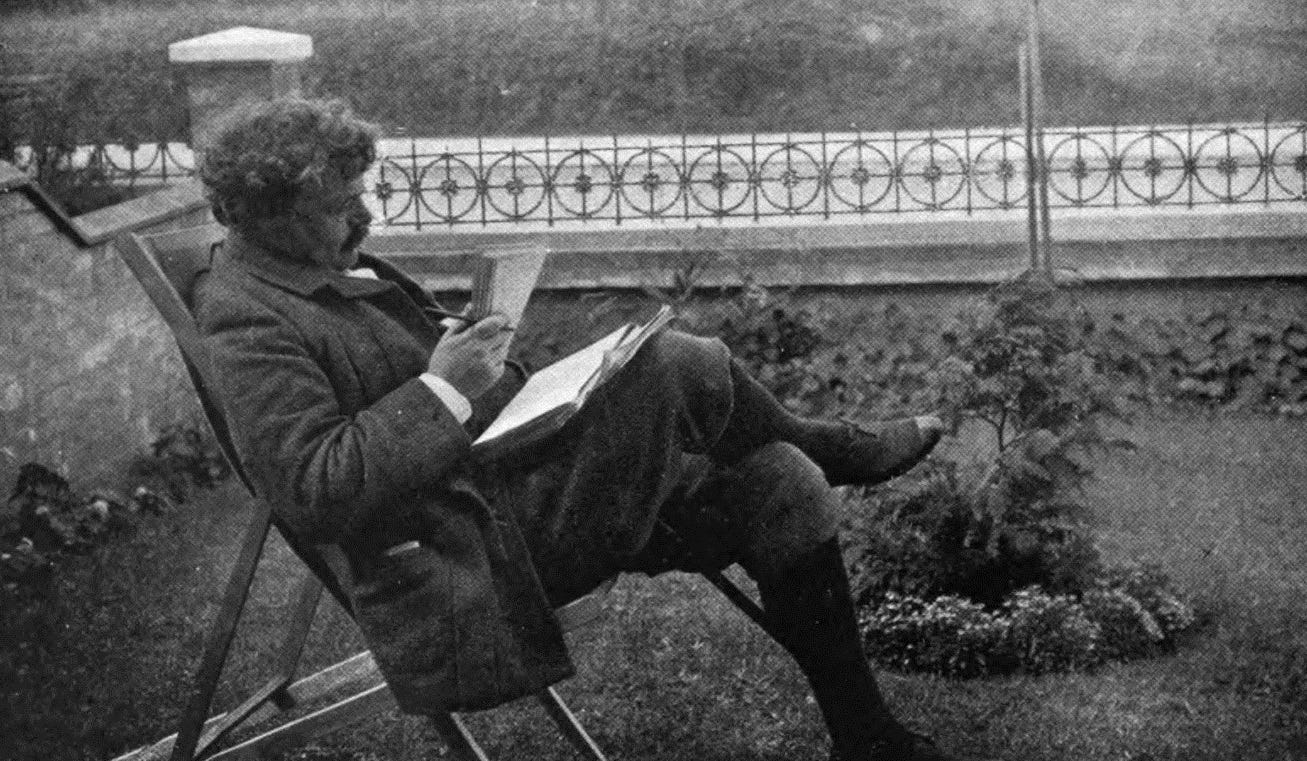
The ever unsurpassable G. K. Chesterton noticed in his Orthodoxy – especially chapter VI, The paradoxes of Christianity – that criticism of the catholic faith is so strange because it is so contradictory. For example, for some it is disturbing that man was elevated above all other creatures, as being made in the image and likeness of God, for others that man is humiliated and humility is praised as the ground of all virtues. But of course it’s no good to paraphrase Chesterton:
Thus, certain sceptics wrote that the great crime of Christianity had been its attack on the family; it had dragged women to the loneliness and contemplation of the cloister, away from their homes and their children. But, then, other sceptics (slightly more advanced) said that the great crime of Christianity was forcing the family and marriage upon us; that it doomed women to the drudgery of their homes and children, and forbade them loneliness and contemplation.
He goes over example after example of the contradictory critics of Christianity, only to find that therein lies precisely the key:
And then in a quiet hour a strange thought struck me like a still thunderbolt. There had suddenly come into my mind another explanation. Suppose we heard an unknown man spoken of by many men. Suppose we were puzzled to hear that some men said he was too tall and some too short; some objected to his fatness, some lamented his leanness; some thought him too dark, and some too fair. One explanation (as has been already admitted) would be that he might be an odd shape. But there is another explanation. He might be the right shape. Outrageously tall men might feel him to be short. Very short men might feel him to be tall.
This leads to what he called “the thrilling romance of Orthodoxy”: keeping the balance is not a boring middle-of-the-road policy, but a fearsome fight to keep the balance between opposing forces. Read the chapter, or better still, the book, but here is one last quote:
Thus, the double charges of the secularists, though throwing nothing but darkness and confusion on themselves, throw a real light on the faith. It is true that the historic Church has at once emphasised celibacy and emphasised the family; has at once (if one may put it so) been fiercely for having children and fiercely for not having children. It has kept them side by side like two strong colours, red and white, like the red and white upon the shield of St. George. It has always had a healthy hatred of pink. It hates that combination of two colours which is the feeble expedient of the philosophers. It hates that evolution of black into white which is tantamount to a dirty gray. In fact, the whole theory of the Church on virginity might be symbolized in the statement that white is a colour: not merely the absence of a colour. All that I am urging here can be expressed by saying that Christianity sought in most of these cases to keep two colours coexistent but pure.
It is this fearsome balance which, I submit, is or ought to be the genius of catholic political thought and practice ‘in the center’, between the political left and right. Even more so, I submit that the political divide between left and right is not only boring, but a diabolical divide, as are all the other contradictions mentioned by Chesterton. It is just as easy, and just as wrong, to reduce Christianity to a left-wing discourse, or a right-wing discourse. The true prospects for a renewed Christendom lie in overcoming this political divide, for the ‘thrilling romance of the Center’.
So on the one hand, although it is perfectly possible to reduce Christianity (i.e. Catholicism) to a right-wing identitarian discourse (examples abound), it would be too easy, and hence wrong, to do so. Kingsnorth’s ‘Against Christian Civilization’ gives a nice overview of the problems in that approach. We have to love our enemies, pray for those who persecute us. Catholic missionaries used to travel to the other side of the world to convert strangers, instead of hunting for them when they try to come here.
Right-wing reductions of Christianity rightly boast of all the riches of ‘the West’ – be they economic, social, cultural, etc. – but can be selectively deaf when it comes to Christ’s warnings against wealth and the rich. Christianity is the incarnated religion par excellence, but there is a real danger of idolatry when it comes to all the incarnated ‘goodies’ Christianity has given to the West – first and foremost in the idolatry for ‘the West’ as such.
To make one sweeping caricature, in Christ’s double commandment to love God above all else and love your neighbor as yourself, the Right seems to be prone to a preferential option for the first of these two commandments, with a risk of idolatry towards another vertical value – first and foremost the nation and the economy, political power and money, clear temptations from the devil. Our ‘culture’ and ‘identity’ are some other candidates for idolatry.
On the other hand, it is just as easy and just as wrong to reduce Christianity to a left-wing humanitarian discourse – and Kingsnorth’s essay does little against that danger, starting with a lurking theological irenism. The thrilling romance of the Church combines the contradictory aspects of sectarianism and truly universal ‘catholicism’. Starting from that double commandment, the Left certainly has a penchant for the second of these two commandments, for example with a ‘preferential option for the poor’.
But when Mary of Bethany (in the gospel of John) poured all of the expensive oil on Jesus’s feet, it was Judas Iscariot who said “Why was not this ointment sold for three hundred pence, and given to the poor?” to which Jesus replied “For the poor you have always with you; but me you have not always.” This looks more like a preferential option for liturgical exuberance than a preferential option for the poor. This focus on the love for one’s neighbor at the expense of, eventually, all else, becomes a form of idolatry in itself of course. The Right has the nation, family values, property, Western Civilization, etc., the Left has tolerance, equality, care for the poor, the weak, and eventually wokeism.
Moreover, the pendulum of time moves from the left to the right and back, emboldening each time these right-wing and left-wing reductions by exaggerating the distortions of the other side. The first challenge is therefore to categorically reject this left-right divide as a diabolical divide et impera (divide and conquer) tactic. Whatever truth there may be in this division, you neither talk to the devil, nor talk like the devil. As St. Paul warned us: “For our wrestling is not against flesh and blood; but against principalities and powers, against the rulers of the world of this darkness, against the spirits of wickedness in the high places.” (Eph. 6: 12). That is perhaps the single most important verse for a political vision for Christendom – arguably more important than “give to Caesar what belongs to Caesar, and give to God what belongs to God.”, because the whole question is what belongs to Caesar and what belongs to God.
The truly important categorical distinctions are eternal versus temporary, truth versus falsehood, dogma versus heresy, and yes, catholic versus non-catholic. The danger of sectarianism in that last distinction is real, but it is at the same time the crucial glue for a truly universal (global, catholic) community – and crucially mitigated by the love for one’s enemy, as Christ prayed for those who were killing Him. Is this dangerous and risky? Yes it is, but then again we turn to Chesterton:
It was no flock of sheep the Christian shepherd was leading, but a herd of bulls and tigers, of terrible ideals and devouring doctrines, each one of them strong enough to turn to a false religion and lay waste the world. Remember that the Church went in specifically for dangerous ideas; she was a lion tamer.
Christ’s kingship as expressed in Quas Primas is the starting point of course, but perhaps this crucial point, which arguably got bogged down in the second half of the 20th century, needs a crucial counterweight to achieve an enduring balance: the social Queenship of Mary …
